The Forgotten Framework That Fixes Your Ads
Most marketers know when something’s off. The numbers tell the story: view rates drop, click-throughs flatline, and cost per acquisition creeps up. But after identifying the problem, what do most teams do?
They make more content. More hooks. More edits. More versions. They crank up volume thinking more shots on goal means better odds.
But here’s the truth: volume isn’t a strategy. Diagnosis is.
In a world where AI tools spit out thousands of generic creatives by the hour, the edge isn’t speed. The edge is knowing what’s broken and how to fix it. That’s where one of the oldest frameworks in marketing - AIDA - becomes your best-performing tool in 2025.
What Is AIDA, Really?
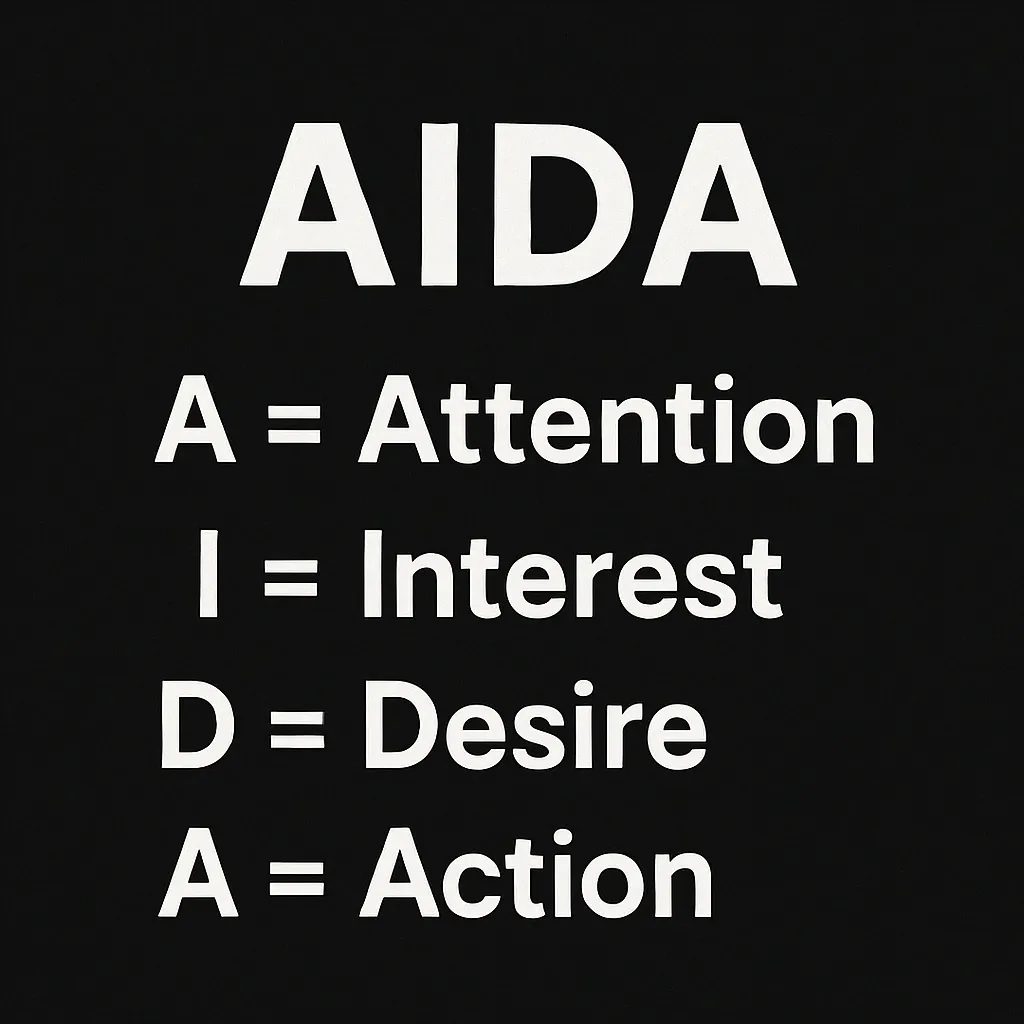
AIDA stands for:
Attention
Interest
Desire
Action
It’s been around since the 1800s. But just because it’s old doesn’t mean it’s outdated. In fact, most performance teams today are ignoring it entirely. That’s a mistake.
Every single ad you run can be mapped back to these four stages. And every major drop in performance? You can trace it back to a breakdown in one of them.
Let’s make it real:
Attention = 3-second view rate (VVR). Are people stopping the scroll? If not, your visuals or opening frame probably suck.
Interest = Hold rate. Did they stick around? If not, your pacing is off or the story flops.
Desire = Click-through rate. If they watched but didn’t click, your offer’s not clear - or not compelling.
Action = Conversion rate. If they clicked but didn’t convert, your landing page and ad are out of sync.
This isn’t theoretical. These are the exact metrics tied to real outcomes. And they give you a way to stop guessing and start fixing.
The Data-Driven Difference
One of our recent calls - with a talented creator working with H&M - perfectly captured this shift. They knew how to make stunning edits. The kind of videos that look beautiful and feel cinematic. But they weren’t converting.
Why? Because no one could tell what the ad was actually for.
There was no story arc. No reveal. No connection between the viewer’s experience and the intended outcome.
We walked through the AIDA framework and broke it down:
Grab attention, visually, in frame one.
Build interest by establishing narrative stakes.
Drive desire by connecting emotionally to the outcome.
Trigger action with clarity - what do you want them to do, and why?
By the end of the call, they had a structure. A process. A reason behind every frame.
Don’t Just Guess - Fix It
At Flux Cap, we don’t make creative “just to try something new.” We make it to solve real problems. Our editors are trained to look at the data, map it to the AIDA framework, and produce content that performs.
If your team is stuck rewriting hooks, tweaking intros, and hoping something sticks - we should talk.
We’re not here to make more stuff. We’re here to make stuff that works.
Want help diagnosing what’s broken - and fixing it?
Book a free 20-minute call: https://www.fluxcap.ai/call-with-paul
Tags: #MarketingFrameworks #CreativeStrategy #AIDA #PerformanceMarketing


